











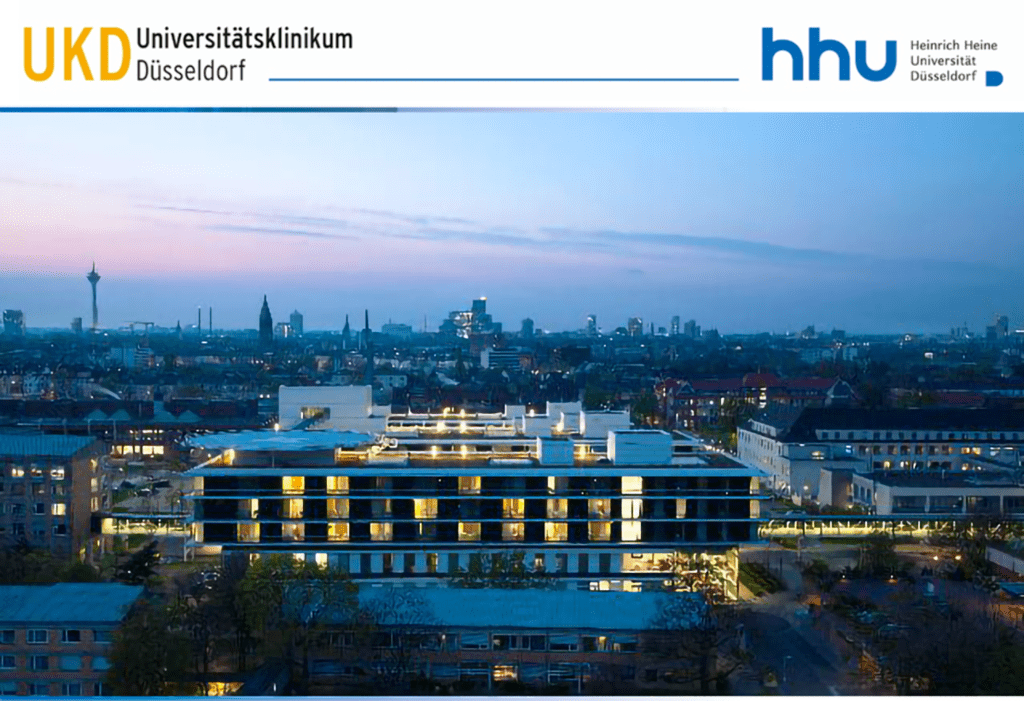
The University Hospital Düsseldorf (UKD) is the largest hospital in the state capital and one of the most important medical centers in North Rhine-Westphalia. Around 9,300 employees at UKD and its subsidiaries ensure that more than 45,000 patients receive inpatient treatment each year and over 270,000 are treated on an outpatient basis. UKD stands for international excellence in patient care, research, and teaching, as well as for innovative and safe diagnostics, therapy, and prevention.
Patients benefit from the intensive interdisciplinary collaboration of 60 clinics and institutes. A particular strength of the university hospital is the close integration of clinical practice and research, enabling the safe application of new methods. At UKD, the medicine of tomorrow is being created-every day.
The Faculty of Medicine at Heinrich Heine University Düsseldorf is a leading center for research-driven medicine. Its projects and collaborations in basic and clinical research are funded, among others, by the German Research Foundation, federal and state ministries, and the European Union.
For the Interdisciplinary Cardiometabolic Imaging of the Center for CARDiovascular Research in DIABetes (CARDDIAB) at Heinrich Heine University we are announcing1 Postdoctoral Positions (m/f/d), full-time,
This is a qualification position within the definition of the ”Wissenschaftszeitvertragsgesetz” (WissZeitVG according to § 2 para. 1).
A key research focus at the Center for Magnetic Resonance in CARDDIAB (CMRC) is the analysis of metabolic fluxes in vivo, with the aim of non-invasively characterizing metabolic changes at various stages of cardiac (heart failure, ischemic cardiomyopathy) and metabolic health (fatty liver disease, prediabetes, diabetes mellitus). In the long term, this research is expected to lead to novel therapeutic interventions. To achieve these goals, the CMRC has a unique translational imaging platform that includes:
To investigate metabolic fluxes in real time, MR imaging using hyperpolarized 13C-labeled substances (HP13C MRI) will be employed in animal models and in humans. This technique presents specific challenges, such as those related to the handling of the substances (short-lived hyperpolarization) and the MR measurement protocols used. Recently, the CMRC successfully introduced HP13C MRI using [1-13C] pyruvate in diabetic mouse models. The next step is to establish measurement and analysis protocols that can be routinely applied in various metabolic studies of muscle, liver, and heart tissues.
Patients benefit from the intensive interdisciplinary collaboration of 60 clinics and institutes. A particular strength of the university hospital is the close integration of clinical practice and research, enabling the safe application of new methods. At UKD, the medicine of tomorrow is being created-every day.
The Faculty of Medicine at Heinrich Heine University Düsseldorf is a leading center for research-driven medicine. Its projects and collaborations in basic and clinical research are funded, among others, by the German Research Foundation, federal and state ministries, and the European Union.
For the Interdisciplinary Cardiometabolic Imaging of the Center for CARDiovascular Research in DIABetes (CARDDIAB) at Heinrich Heine University we are announcing
1 Postdoctoral Positions (m/f/d), full-time,
initially limited for 5 years
This is a qualification position within the definition of the ”Wissenschaftszeitvertragsgesetz” (WissZeitVG according to § 2 para. 1).
A key research focus at the Center for Magnetic Resonance in CARDDIAB (CMRC) is the analysis of metabolic fluxes in vivo, with the aim of non-invasively characterizing metabolic changes at various stages of cardiac (heart failure, ischemic cardiomyopathy) and metabolic health (fatty liver disease, prediabetes, diabetes mellitus). In the long term, this research is expected to lead to novel therapeutic interventions. To achieve these goals, the CMRC has a unique translational imaging platform that includes:
- a clinical 3T and 7T MRI system
- two 9.4T small-animal scanners
- hyperpolarization technologies
- a comprehensive infrastructure for translational cardiometabolic research
To investigate metabolic fluxes in real time, MR imaging using hyperpolarized 13C-labeled substances (HP13C MRI) will be employed in animal models and in humans. This technique presents specific challenges, such as those related to the handling of the substances (short-lived hyperpolarization) and the MR measurement protocols used. Recently, the CMRC successfully introduced HP13C MRI using [1-13C] pyruvate in diabetic mouse models. The next step is to establish measurement and analysis protocols that can be routinely applied in various metabolic studies of muscle, liver, and heart tissues.
Your responsibilities
As part of the HP13C team, your role will focus on developing standardized processes for HP13C MRI in order to ensure high-quality, reproducible results over the long term. This includes, in particular:
- Establishing and helping to shape HP13C MRI for studies in small animal models, with a specific focus on the use of HP [1-13C] pyruvate, and, at a later stage, translating the approaches to studies in large animal models and potentially humans
- Developing corresponding data analysis software
- Conducting, evaluating, and interpreting ongoing HP13C MRI studies at the CMRC, e.g., at the intersection of heart failure and diabetes
- Development of new methods for HP13C MRI at the CMRC, with a focus on establishing new hyperpolarized substances for cardiometabolic research
What do we expect?
- University degree in the natural sciences or engineering
- PhD related to Physics, Medical Physics, Chemistry, or comparable
- Experience in conducting HP13C MRI measurements
- Programming skills in Matlab / Python
- Distinct ability to work in a team
Desirable additional qualifications
- Experience in working with MRI systems from Bruker and Siemens
- Experience in sequence programming on these platforms
- Experience in MR imaging of small animals, large animals, or humans
- Interest in cardiometabolic research
Which additional skills do you need?
- Enthusiasm for new tasks
- Ability to work on complex problems in a goal- and solution-oriented manner
- Adequate communication skills
- Very good oral and written communication skills in English and preferably also in German
What do we offer?
You can expect a range of varied tasks with a great deal of freedom in a creative and dynamic team with performance-based salary according to TVL E13. We offer you exciting opportunities for scientific cooperation and the initiation of new projects. Our common aim is to raise cardiometabolic MRI within CARDDIAB to the next level and to unveil new horizons at the interface of cardiovascular and diabetes/metabolic research. Habilitation opportunities are available.
For any questions regarding the job profile, please contact Assist. Prof. Dr. rer. nat. Andreas Korzowski (e-mail: email; phone: +49 (0)211-81 10527).
The employment contract will be concluded with Heinrich-Heine-University Düsseldorf. The Heinrich-Heine-University Düsseldorf seeks to increase the proportion of women in fields where they are underrepresented and therefore expressly encourages qualified women to apply. Women will be given preference if they have the same qualifications, skills, and professional achievements, unless there are compelling reasons related to a male candidate. The Heinrich-Heine-University is certified as a family-friendly institution and promotes the compatibility of academic/professional life and family life. Applications from qualified individuals with severe disabilities and those deemed equivalent under SGB IX are encouraged.
At Heinrich Heine University Düsseldorf, positions are generally also filled on a part-time basis, unless compelling operational reasons preclude this in individual cases.
For any questions regarding the job profile, please contact Assist. Prof. Dr. rer. nat. Andreas Korzowski (e-mail: email; phone: +49 (0)211-81 10527).
The employment contract will be concluded with Heinrich-Heine-University Düsseldorf. The Heinrich-Heine-University Düsseldorf seeks to increase the proportion of women in fields where they are underrepresented and therefore expressly encourages qualified women to apply. Women will be given preference if they have the same qualifications, skills, and professional achievements, unless there are compelling reasons related to a male candidate. The Heinrich-Heine-University is certified as a family-friendly institution and promotes the compatibility of academic/professional life and family life. Applications from qualified individuals with severe disabilities and those deemed equivalent under SGB IX are encouraged.
At Heinrich Heine University Düsseldorf, positions are generally also filled on a part-time basis, unless compelling operational reasons preclude this in individual cases.
Have we sparked your interest?
Then we look forward to receiving your detailed application with the usual documents within two weeks of this advertisement appearing with the reference number 322E/26 to the following address:
bewerbungen@med.uni-duesseldorf.de
or
Universitätsklinikum Düsseldorf
D 01.2.1 - Kennziffer: 322E/26
Moorenstr. 5, 40225 Düsseldorf
bewerbungen@med.uni-duesseldorf.de
or
Universitätsklinikum Düsseldorf
D 01.2.1 - Kennziffer: 322E/26
Moorenstr. 5, 40225 Düsseldorf
Bitte beziehe dich bei deiner Bewerbung auf jobvector
und verwende die folgende Referenznummer:
322E/26
Für diesen Job einen passenden Lebenslauf erstellen und direkt bewerben
Lebenslauf erstellen

