









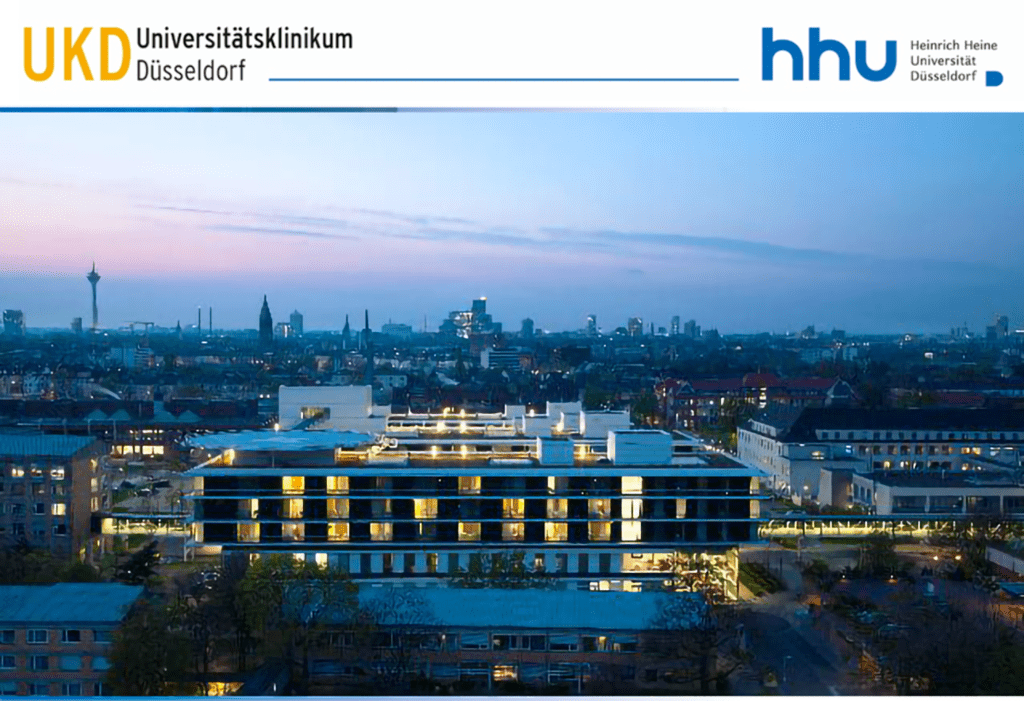
The University Hospital Düsseldorf (UKD) is the largest hospital in the state capital and one of the most important medical centers in North Rhine-Westphalia (NRW). The 9,300 employees at UKD and its affiliated companies are committed to ensuring that more than 45,000 inpatients receive treatment and 270,000 outpatients receive medical care every year. UKD represents international excellence in patient care, research, and teaching, as well as innovative and safe approaches in diagnostics, therapy, and prevention. Patients benefit from the intensive interdisciplinary collaboration of 60 clinics and institutes. The particular strength of the university hospital lies in the close integration of clinical practice and research, enabling the safe application of new medical approaches. The medicine of tomorrow is developed at UKD. Every day.
The Faculty of Medicine at Heinrich Heine University Düsseldorf is a leading center for cutting-edge research in medicine. Its research projects and collaborative programs in basic and clinical research are supported, among others, by the German Research Foundation (DFG), state and federal ministries, and the European Union.
The Institute of Biochemistry und Molecular Biology I is looking for a:
PhD position to investigate ubiquitin signaling pathways and cellular stress responses in humans
Part-time position 65% WAZ
The position is initially limited to two years on a part-time basis. This is a qualification position in accordance with the German Act on Temporary Scientific Contracts (Wissenschaftszeitvertragsgesetz, WissZeitVG, Section 2 (1)).
We are a young research group at the Institute of Biochemistry and Molecular Biology I (Director: Prof. Dr. Andreas Reichert), supervised by Dr. Kai Mayor Völtzke. Our research focuses on fundamental mechanisms of cellular regulation and their importance for cellular function and adaptability.
This project aims to investigate the molecular principles of de-/ubiquitination as a regulatory hub in cell and mitochondrial biology, as well as its contribution to stress responses under various physiological and pathological conditions. Human cell models will be modified using CRISPR/Cas-based genome editing to generate defined mutant cell lines, which will subsequently be functionally characterized. In addition, the influence of the investigated factor on cellular responses to therapeutic interventions will be examined using established cell-based model systems. Advanced molecular biological methods will be employed to identify associated molecular networks and the underlying mechanisms. The project is embedded in a highly interdisciplinary research environment and may also include participation in teaching activities.
The salary is based on the TV-L (collective agreement for public service employees of the German federal states) and assigned to pay grade E13, taking into account previous periods of employment.
The employment contract will be concluded with the Heinrich Heine University Düsseldorf.
Heinrich Heine University Düsseldorf aims to increase the proportion of women in academic positions. Therefore, applications from women will be given preference if qualifications, suitability, and professional performance are equivalent, unless reasons related to another applicant prevail. Heinrich Heine University follows the principle of excellence through diversity. It has signed the Diversity Charter (“Charta der Vielfalt”) and successfully participated in the “Shaping Diversity” audit conducted by the Stifterverband. The university is certified as family-friendly and promotes the compatibility of professional/scientific careers and family life. Applicants with severe disabilities will be given preference if equally qualified.
The Faculty of Medicine at Heinrich Heine University Düsseldorf is a leading center for cutting-edge research in medicine. Its research projects and collaborative programs in basic and clinical research are supported, among others, by the German Research Foundation (DFG), state and federal ministries, and the European Union.
The Institute of Biochemistry und Molecular Biology I is looking for a:
PhD-Student (m/w/d)
PhD position to investigate ubiquitin signaling pathways and cellular stress responses in humans
Part-time position 65% WAZ
The position is initially limited to two years on a part-time basis. This is a qualification position in accordance with the German Act on Temporary Scientific Contracts (Wissenschaftszeitvertragsgesetz, WissZeitVG, Section 2 (1)).
We are a young research group at the Institute of Biochemistry and Molecular Biology I (Director: Prof. Dr. Andreas Reichert), supervised by Dr. Kai Mayor Völtzke. Our research focuses on fundamental mechanisms of cellular regulation and their importance for cellular function and adaptability.
This project aims to investigate the molecular principles of de-/ubiquitination as a regulatory hub in cell and mitochondrial biology, as well as its contribution to stress responses under various physiological and pathological conditions. Human cell models will be modified using CRISPR/Cas-based genome editing to generate defined mutant cell lines, which will subsequently be functionally characterized. In addition, the influence of the investigated factor on cellular responses to therapeutic interventions will be examined using established cell-based model systems. Advanced molecular biological methods will be employed to identify associated molecular networks and the underlying mechanisms. The project is embedded in a highly interdisciplinary research environment and may also include participation in teaching activities.
Your responsibilities:
- Planning, conducting, and analyzing molecular and cell biological experiments
- Generation and functional characterization of human cell models created using CRISPR/Cas9 genome editing
- Investigation of mitochondrial function, stress responses, and metabolic regulation
- Application of advanced proteomic methods to identify protein interaction networks
- Analysis, interpretation, and presentation of scientific results
- Participation in teaching activities
Your profile:
- Completed Master’s degree (or equivalent qualification) in Biology, Biochemistry, Molecular Biology, or a related discipline
- Basic knowledge of molecular and cell biological techniques and a strong interest in experimental research
- Experience with cell culture techniques is advantageous
- Knowledge of mitochondrial biology or cancer biology is considered a plus
- Excellent written and spoken English skills, as the work takes place in an international environment
- Ability to work independently, strong analytical thinking skills, high motivation, and ability to work effectively in a team
We offer:
- A 25.675-hour weekly working schedule
- Work in an internationally connected, interdisciplinary research environment
- Access to modern laboratories and advanced core facilities
- Training in genome editing, molecular biology, and mitochondrial biology
- Support for scientific development and career planning
- Work in a supportive and collaborative young research team
- All benefits customary in the German public sector, including occupational pension scheme
- Affordable catering options
- On-site childcare facilities
- Staff accommodation options
The salary is based on the TV-L (collective agreement for public service employees of the German federal states) and assigned to pay grade E13, taking into account previous periods of employment.
The employment contract will be concluded with the Heinrich Heine University Düsseldorf.
Heinrich Heine University Düsseldorf aims to increase the proportion of women in academic positions. Therefore, applications from women will be given preference if qualifications, suitability, and professional performance are equivalent, unless reasons related to another applicant prevail. Heinrich Heine University follows the principle of excellence through diversity. It has signed the Diversity Charter (“Charta der Vielfalt”) and successfully participated in the “Shaping Diversity” audit conducted by the Stifterverband. The university is certified as family-friendly and promotes the compatibility of professional/scientific careers and family life. Applicants with severe disabilities will be given preference if equally qualified.
For questions regarding the position, please contact:
Dr. rer. nat. Kai Mayor Völtzke (Email: email or Phone: +49 (0)211-81-13657)
By submitting application documents, applicants agree that these documents become the property of the University Hospital Düsseldorf and will not be returned due to administrative costs.
If you would like to apply, please submit the following documents within two weeks after publication of the advertisement, preferably by email:
Dr. rer. nat. Kai Mayor Völtzke (Email: email or Phone: +49 (0)211-81-13657)
By submitting application documents, applicants agree that these documents become the property of the University Hospital Düsseldorf and will not be returned due to administrative costs.
If you would like to apply, please submit the following documents within two weeks after publication of the advertisement, preferably by email:
- Curriculum vitae (CV)
- Academic records/transcripts and certificates
- Description of your research experience and research interests
- Indication of your earliest possible starting date
- References
Bitte beziehe dich bei deiner Bewerbung auf jobvector
und verwende die folgende Referenznummer:
319E/26
Für diesen Job einen passenden Lebenslauf erstellen und direkt bewerben
Lebenslauf erstellen

