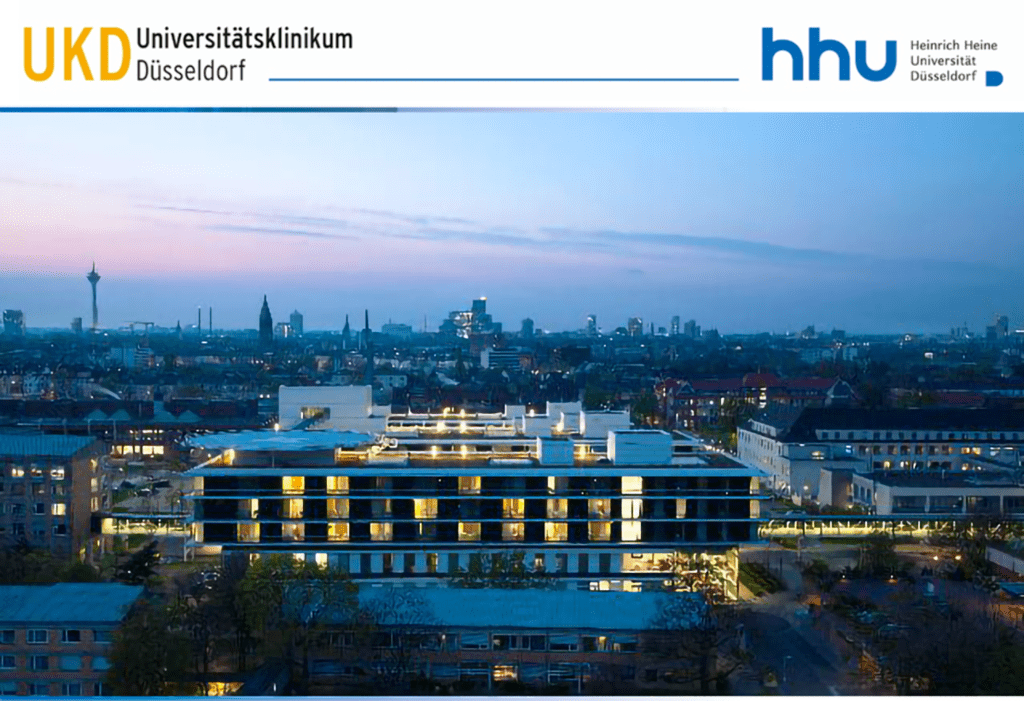
Düsseldorf University Hospital (UKD) is the largest hospital in the state capital and one of the most important medical centers in North Rhine-Westphalia. The 9,300 employees at UKD and its subsidiaries are committed to treating over 45,000 inpatients and 270,000 outpatients every year. The UKD stands for international excellence in patient care, research and teaching, as well as for innovative and safe diagnostics, therapy and prevention. Patients benefit from the intensive interdisciplinary cooperation between the 60 clinics and institutes. The particular strength of the University Hospital is the close integration of clinical and research work for the safe application of new methods. Tomorrow's medicine is being created at the UKD. Every day.
As part of a joint initiative organized by the Graduate School (integrated Research Training Group, iRTG) of the German Research Foundation (DFG)-funded Collaborative Research Center (CRC) 1774 “Cardio-Diabetes Crosstalk (CARDDIAB),” we are seeking, starting October 1, 2026, a
doctoral researcher (m/f/d)
This is a three-year fixed-term training position in accordance with the German Act on Fixed-Term Academic Contracts (WissZeitVG, pursuant to Section §2(1)).
About the CRC 1774
The CRC 1774 investigates how key metabolic “promoter organs”-adipose tissue, bone marrow, the gut, and the liver-communicate with the cardiovascular system and thereby influence the progression from health through prediabetes and type 2 diabetes to cardiovascular diseases. By combining comprehensively characterized patient cohorts with state-of-the-art multi-omics technologies, innovative imaging techniques, and methods from data science and artificial intelligence, the project aims to decipher the mechanisms underlying cardiometabolic diseases and develop new approaches for precision medicine at the interface of diabetology and cardiology.
Doctoral students work on interdisciplinary research projects spanning basic, translational, and clinical research. The focus is on organ-to-organ communication, metabolic regulation, inflammatory processes, cellular energy metabolism, and cardiovascular complications of diabetes within a highly collaborative and international research environment.
Doctoral Project:
As part of your doctoral project, you will integrate metabolic imaging with multi-omics data, including microbiome sequencing, transcriptomics, proteomics, lipidomics, metabolomics, and exosome profiling. Using these integrated datasets, you will develop genome-wide metabolic models (GEMs) as well as machine learning-based analysis pipelines aimed at identifying flux-based biomarkers for cardiovascular complications.
Your Profile:
Master’s degree in bioinformatics, computational biology, computer science, systems biology, data science, or a related field
Strong interest in the analysis of multi-omics data, metabolism, and translational biomedical research
Experience in programming and statistical data analysis, preferably in C/C++, Rust, Java, R, or Python
Experience analyzing at least some of the following data types: RNA-Seq, metagenomics, proteomics, lipidomics, metabolomics, or datasets related to extracellular vesicles/exosomes
Interest in or prior knowledge of constraint-based modeling or genome-level metabolic models
Excellent communication skills in English
We expect
Outstanding academic performance and a strong motivation for scientific work
Enthusiasm for the interdisciplinary research program of CRC 1774
Active participation in the structured training program and the scientific activities of the Integrated Graduate School
Willingness to engage in interdisciplinary collaboration and academic exchange within the CRC 1774
Timely production of scholarly publications and the doctoral dissertation
Compliance with the DFG guidelines for ensuring good scientific practice and the principles of responsible research
Compensation is provided in accordance with the provisions of the TV-L (Collective Bargaining Agreement for the Public Sector in the State of North Rhine-Westphalia) in pay grade E13, with all prior service credited in accordance with the collective bargaining regulations.
The contract will be concluded with Heinrich Heine University.
Heinrich Heine University Düsseldorf is committed to increasing the proportion of women on its faculty. Applications from women will therefore be given preferential consideration if they have equal qualifications, competence, and academic achievement, unless there are compelling reasons related to a male candidate that take precedence. Heinrich Heine University upholds the principle of excellence through diversity. It has signed the “Diversity Charter” and successfully participated in the Stifterverband’s “Shaping Diversity” audit. It is certified as a family-friendly university and promotes the compatibility of academic/professional life with family life. Applications from qualified individuals with severe disabilities and those deemed equivalent under SGB IX are encouraged.
We offer:
A dynamic, interdisciplinary, and international research environment at the intersection of metabolic, cardiovascular, and systems medicine, with excellent research infrastructure and comprehensively characterized clinical cohorts
Individual supervision and mentoring by internationally renowned scientists from basic research, translational research, and clinical practice
A structured doctoral program featuring lectures, workshops, methodology courses, opportunities to acquire cross-disciplinary skills, and interdisciplinary and international exchange opportunities
Access to state-of-the-art technologies, including multi-omics, high-resolution imaging, data science/artificial intelligence, and precision medicine platforms
Involvement in national and international scientific networks, collaborations, career development initiatives, and support for participation in scientific conferences
Application Materials and Selection Process:
Please submit the following documents as a single PDF file:
Letter of motivation (maximum one page)
Resume in table format
Complete transcripts, including the diploma certifying eligibility for university admission (Abitur or equivalent)
Master’s thesis (or equivalent academic thesis) as a separate PDF file
An Academic Letter of Recommendation
Please submit your application electronically to the iRTG Office (email).
Further information can be found on the CRC’s website. If you have any project-related or organizational questions, please feel free to contact the CRC/iRTG Coordination Office.
Jetzt bewerben
Bitte beziehe dich bei deiner Bewerbung auf jobvector
und verwende die folgende Referenznummer:
375E 26
Es handelt sich hierbei um einen Schätzwert. Je nach Erfahrung, Qualifikation, Standort sowie weiteren Faktoren kann dieser Wert von der tatsächlich zu erwartenden Vergütung abweichen.
Der angegebene Wert ist das geschätzte durchschnittliche Bruttojahresgehalt für vergleichbare Vollzeitpositionen.
Das Universitätsklinikum Düsseldorf ist das größte Krankenhaus in der Landeshauptstadt und eines der wichtigsten medizinischen Zentren in NRW. Die rund 9.300 Mitarbeiterinnen und Mitarbeiter in UKD und Tochterfirmen setzen sich dafür ein, dass jährlich über 45.000 Patient:innen und Patienten stationär behandelt und 270.000 ambulant versorgt werden...
Gibt es die Möglichkeit, im Homeoffice zu arbeiten?
Die Stelle wird vor Ort bei Universitätsklinikum Düsseldorf ausgeübt.
Wie kann ich mich auf den Job bewerben?
Bewirb dich direkt über den “Jetzt bewerben”-Button in der Stellenanzeige. Du hast noch keinen Lebenslauf? Mit unserem
Lebenslauf-Generator
erstellst du in wenigen Minuten ein passendes Dokument.
Wie sollte mein Lebenslauf für diese Stelle aussehen?
Wenn du Hilfe bei der Gestaltung deines Lebenslaufs benötigst, kannst du unsere
Lebenslauf-Vorlagen
zur Hilfe nehmen. Dort findest du passende Vorlagen für verschiedene Berufsfelder – wie zum Beispiel
Bioinformatiker
,
Biologe
oder
Bioinformatiker
– sowie hilfreiche Tipps zu Gestaltung, Aufbau und Inhalt.
Wie hoch ist das Gehalt für diesen Job?
Das Unternehmen hat keine Angaben zur Höhe des Gehalts gemacht. Vergleichbare Vollzeitpositionen erhalten ein geschätztes, durchschnittliches Bruttojahresgehalt von 57708.82€. Mehr Informationen zum Durchschnittsgehalt als
Bioinformatiker
findest du auf unseren
Gehaltsseiten
. Oder berechne direkt deinen Nettolohn mit unserem